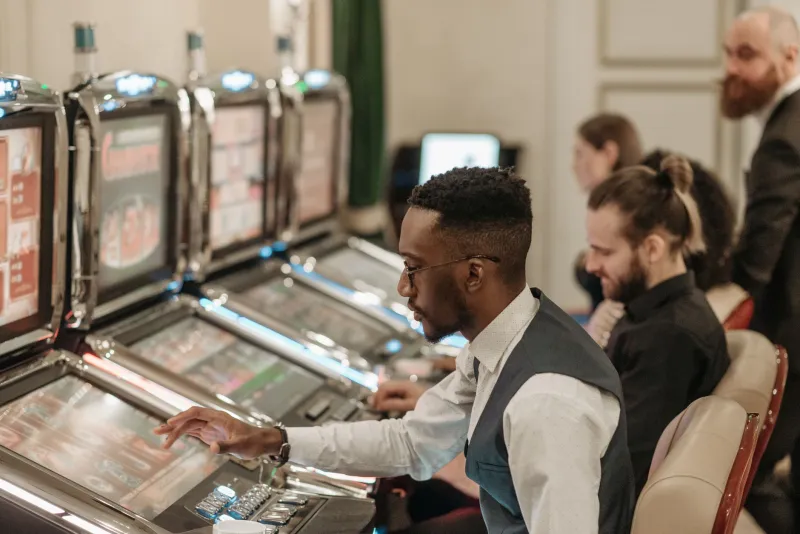
Stuck in the Spin Cycle: How Aussie Pub and Club Pokies Are Designed to Never Let You Leave

Picture this: you sit down at a pokie machine at your local RSL, planning to burn through twenty bucks before the footy starts. An hour later, you're still there. You haven't won big. You haven't even particularly enjoyed the last thirty minutes. But somehow, you're still spinning. Sound familiar?
For millions of Australians who play at pubs and clubs every week, this experience isn't a quirk of personal willpower — it's the intended outcome of a carefully constructed environment. Unlike online platforms, which are increasingly required to offer players tools to manage their play, physical venue pokies in Australia operate in a regulatory grey zone that makes it remarkably easy to stay glued to the machine and surprisingly difficult to step away.
Let's break down exactly how that happens.
The Pause Button That Nobody Built
If you've ever played pokies through a licensed online casino, you've probably noticed the suite of responsible gambling tools baked into the platform. Session timers. Deposit limits. Reality checks that pop up mid-session reminding you how long you've been playing. Cooling-off periods you can activate with a few taps.
Now walk into your local. Where's the equivalent?
The honest answer: it largely doesn't exist at the machine level. Australian venue pokies are not required to display session timers on screen. They don't prompt you to take a break after a set period. They don't show you a running tally of what you've spent in real time in a way that's easy to read or emotionally register. The closest thing most machines offer is a credit display — which, as any experienced player knows, quickly becomes an abstracted number that loses its connection to real dollars.
The regulatory frameworks governing electronic gaming machines (EGMs) vary significantly between states and territories. In Victoria, New South Wales, and Queensland — three of the country's biggest pokie markets — there are rules around maximum bet sizes and note acceptors, but mandated on-machine player tools remain patchy at best. Industry bodies have long lobbied against mandatory pre-commitment systems, and while some states have experimented with voluntary schemes, uptake has been minimal.
Venue Design Isn't Neutral — It's Strategic
Beyond the machines themselves, the physical environment of Australian gaming rooms is a masterclass in removing natural exit cues. Consider a few design elements that might seem mundane but serve a specific psychological purpose:
No clocks, no windows. This is practically a cliché at this point, but it remains true of the vast majority of Australian gaming rooms. Without external time cues, players lose track of how long they've been sitting there. The absence of natural light removes the body's instinctive awareness that time is passing.
Ambient sound that never resolves. The soundscape in a gaming room is engineered to feel perpetually mid-action. Near-miss sounds, celebratory jingles from machines nearby, and the low hum of constant activity all create a sense that something is always about to happen. Leaving during this state feels like walking out of a film before the ending.
Seating designed for endurance, not comfort. Gaming chairs at venues are typically supportive enough to prevent discomfort but not so comfortable that you'd drift off. They're calibrated for extended sitting without prompting the kind of fidgeting or restlessness that might make you stand up and stretch your legs — or your legs toward the exit.
Cashless and card-based systems. The gradual shift toward cashless gaming in some states has removed one of the most natural stopping points a player has: running out of physical notes. When your losses are absorbed into a tap-and-go transaction, the psychological weight of each dollar diminishes significantly.
Why Online Platforms Are Different — And Why That Gap Matters
It would be unfair to paint online casinos as paragons of responsible gambling. They have their own issues. But from a regulatory standpoint, licensed online platforms operating in Australia (and the international platforms Aussies commonly use) are under considerably more pressure to implement player protection tools.
The National Consumer Protection Framework for online wagering, introduced in 2019, mandated things like default deposit limits and opt-out options for inducements. While that framework applies to wagering rather than online pokies specifically, it reflects a broader regulatory philosophy: digital platforms must actively give players the ability to pump the brakes.
Venue-based pokies have largely escaped equivalent pressure. The political economy around clubs and pubs — particularly in NSW, where the clubs sector wields enormous influence — has historically made meaningful reform slow and difficult. The result is a two-speed system where your ability to self-manage is significantly better on your phone than it is at your local.
What Happens When There's No Natural Stopping Point?
Research into gambling behaviour consistently shows that decision fatigue is real, and that players are far more likely to make poor choices the longer a session runs without interruption. Natural stopping points — finishing a drink, a friend getting up to leave, a machine paying out — serve as unconscious permission slips to stop playing.
Venue design systematically eliminates as many of these moments as possible. Table service means you don't have to get up for a drink. Attendants come to you for ticket payouts. The layout of the room often means you don't have to walk past the exit to reach the bathroom. Every potential off-ramp is quietly closed off.
This isn't a conspiracy theory — it's documented design philosophy, and some of it has been acknowledged by the industry itself in various submissions to regulatory inquiries over the years. The goal is dwell time. Longer sessions mean more revenue. That's not unique to pokies — it's how most entertainment venues operate. But when the product in question carries genuine addiction risk, the ethical calculus shifts.
What Can You Actually Do About It?
If you're a regular at your local and this is starting to sound uncomfortably familiar, there are a few practical moves worth knowing about.
Many states run voluntary exclusion schemes that allow you to ban yourself from gaming venues. It's not glamorous, but it works. Services like GambleAware and the Gambling Help Online line (1800 858 858) can also connect you with support tailored to Australian players.
At a practical level, setting a hard cash limit before you enter — and leaving your card at home — remains one of the most effective friction-based strategies available to you. It reintroduces the stopping point that venue design has tried to remove.
And if you're pushing for change at a policy level, it's worth knowing that several advocacy groups are actively campaigning for mandatory pre-commitment systems and on-machine session tools in Australian venues. The more Aussies understand how the current setup works — and doesn't work in their favour — the stronger that case becomes.
The machines aren't going anywhere. But understanding the environment you're walking into is the first step toward making it work for you, not against you.